
U peptide ciclicu RGDfK hè un ligandu specificu per u receptore di l'integrina αvβ3, è a so sintesi generalmente adopta a strategia di sintesi di peptide in fase solida (SPPS) cumminata cù ciclizazione in fase liquida. U percorsu sinteticu tipicu hè custituitu di quattru tappe principali: assemblea lineale di a catena peptidica, deprotection di a catena laterale, ciclizazione intramolecular è purificazione finale. A strategia di prutezzione basata nantu à a chimica Fmoc hè diventata u metudu di sintesi mainstream per via di e so cundizioni di reazione lieve è di e caratteristiche di deprotezzione efficaci. Tuttu u prucessu di sintesi deve esse realizatu sottu un cuntrollu strettu di a temperatura di reazione, u pH è u sistema di solvente per assicurà a purità è l'attività biologica di u pruduttu finali.
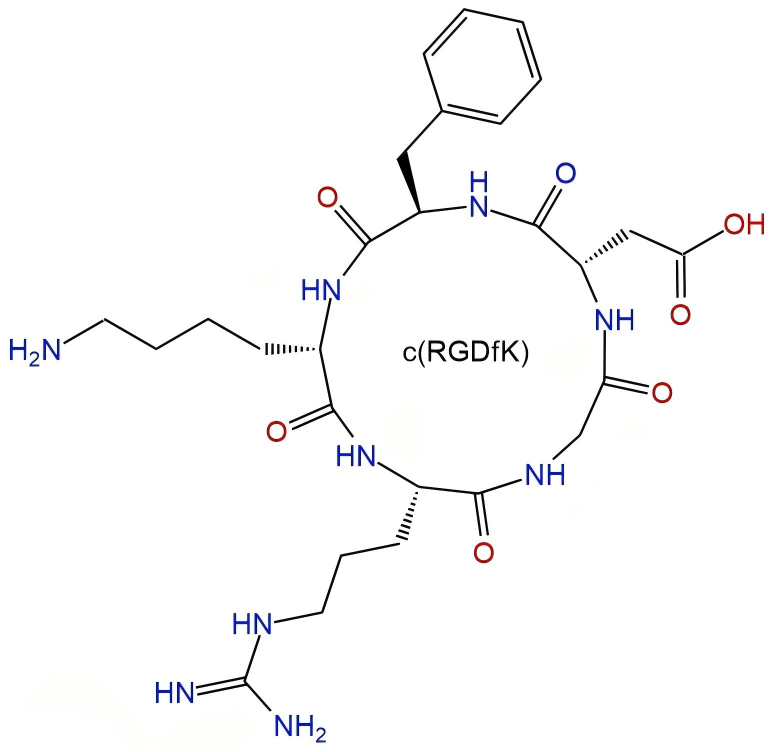
Formula strutturale chimica di peptide ciclicu RGDfK
infurmazione basi
nome cinese: peptide ciclicu RGDfK
nome inglese: c (RGDfK)
No. di cumpagnia: GT-H005
CAS No.: 161552-03-0
sequenza: ciclo (Arg-Gly-Asp-d-Phe-Lys)
formula molekulari: C27H41N9O7
pesu molekulari: 603,67
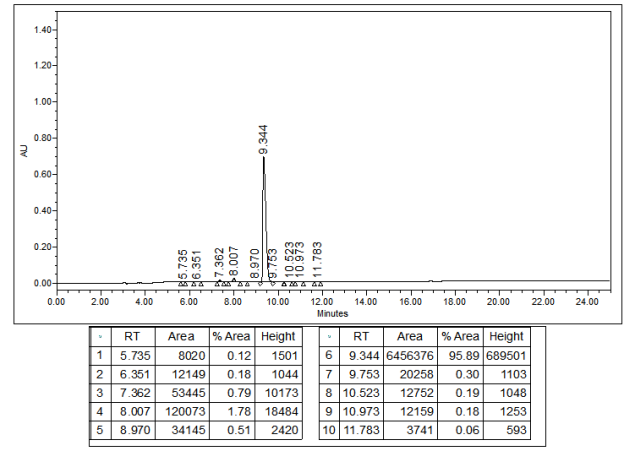
Profil HPLC di peptide ciclicu RGDfK
sintesi in fase solida di catene peptidiche lineari
a custruzzione di a catena peptide lineare principia cù u pretrattamentu di resina Wang. 0,1 mmol di resina Wang hè stata posta in un vasu di sintesi di polietilene polypeptide è lavata in sequenza cù DMF, DCM, è IPA 4 volte per 1 minutu ognunu, seguitatu da gonfiore in DCM per 1 ora. U primu aminoacidu Fmoc-Leu hè statu accoppiatu cù una strategia di pre-attivazione: 234 mg di Fmoc-Leu (4 eq) sò stati attivati cù 57 μL di DCC (4 eq), 54 μL di piridina (6 eq) in DCM anidru per 5 minuti è dopu aghjuntu à u sistema di resina per reagisce durante a notte. L'accoppiamentu di l'aminoacidu sussegwenti hè statu realizatu cù e prucedure standard di Fmoc: u gruppu protettivu Fmoc hè statu prima deprotettu cù 20% di soluzione di piperidina / DMF (2 x 7 min), seguita da l'accoppiamentu di 2 equivalenti di aminoacidu protetti Fmoc cù 1.95 equivalenti di BOP, 2 equivalenti di HOBt in DMM-5 per 4 HOBt. attivazione.
In particulare, l'intruduzioni di l'acidu asparticu (D) è di a fenilalanina (f) richiede una manipulazione speciale. L'acidu asparticu hè di solitu prutettu da a catena laterale OtBu, mentre chì a fenilalanina hà bisognu di utilizà a cunfigurazione D-forma per rinfurzà a specificità di ubligatoriu di u receptore. U gruppu ε-amino di lisina (K) deve esse prutettu cù Boc per a ciclizazione successiva. Dopu ogni passu di l'accoppiamentu, u reagentu Kaiser hè utilizatu per detectà u cumpletu di a reazione, è l'accoppiamentu incompletu deve esse ripetutu finu à chì a reazione hè cumpleta.

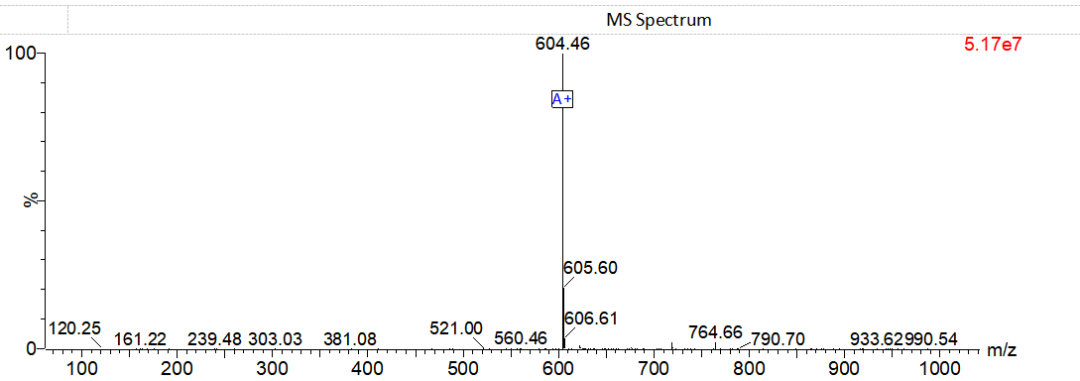
Peptide ciclicu RGDfK MS Figura
Tecnulugia chjave di Cyclization Reaction
dopu à a sintesi di a catena di peptide lineari hè cumpletata, l'implementazione successu di a reazzione di ciclisazione dipende da u cuntrollu precisu di trè passi chjave. Prima, una mistura di TFA:TIPS:H₂ O (95:2.5:2.5) hè aduprata per chjappà a catena peptidica da a resina mentre sguassate a maiò parte di i gruppi di prutezzione di a catena laterale. U prucessu deve esse agitatu cuntinuu per 2 ore. Dopu chì a scissione hè stata cumpleta, a resina hè stata lavata cù TFA:CH₂ Cl₂(1:9), i filtrati cumminati sò stati cuncentrati à un voluminu di circa 1 mL, è u peptide brutu hè precipitatu da l'aghjunzione di etere friddu.
A reazzione di cyclization stessu hè di solitu realizatu in suluzione diluita (concentrazione 0,1-0,5 mM) per suppressà e reazzioni laterali intermoleculari. BOP (86 mg), HOBt (27 mg) è NMM (50 μL) sò stati usati cum'è reagenti di condensazione in DMF per 12-24 ore. U prugressu di a reazzione pò esse monitoratu da HPLC è a reazzione hè cunsiderata cumpleta quandu l'area di u piccu di precursore lineale hè sottu à 5% di u valore iniziale. Per e sequenze RGDfK chì cuntenenu a fenilalanina in forma D, i rendimenti di ciclizazione eranu tipicamente finu à u 60-75%, significativamente più altu ch'è per l'analogi di forma L completa.
Table 1 Comparazione di l'effetti di e diverse cundizioni di ciclisazione nantu à u rendiment
| solvente | temperatura (°C) | tempu di reazione (h) | rendiment (%) | |
| BOP/HOBt/NMM | DMF | 25 | 24 | 68 |
| HATU/DIEA | DMF | 25 | 18 | 72 |
| PyBOP/HOAt/DIEA | DMF/CH₂Cl₂(1:1) | 15 | 36 | 65 |
| DPPA/NMM | DMF | 4 | 48 | 58 |
purification and characterization techniques
the crude product was purified by preparative reversed-phase high performance liquid chromatography (RP-HPLC) with C18 column as stationary phase and water/acetonitrile (containing 0.1%TFA) as mobile phase for gradient elution. The optimized elution procedure was an initial hold of 10% acetonitrile for 5 minutes followed by a linear increase to 60% acetonitrile over 30 minutes. The target peak was collected according to the retention time to give pure white to off-white powder after lyophilization.
The product quality control needs to be verified by a variety of analytical techniques: mass spectrometry (MS) confirms the molecular weight (theoretical value 603.67),HPLC purity analysis needs to reach more than 95%, and circular dichroism (CD) verifies the cyclic conformation characteristics. It is worth noting that the presence of D-type phenylalanine gives the product a characteristic CD negative peak around 214 nm, which is an important indicator of conformational correctness. Hydrogen nuclear magnetic resonance spectroscopy (¹ H NMR) can further confirm the correct linkage sequence and configuration of each amino acid residue.
Common Problems and Solutions
in the actual synthesis process, researchers often encounter several typical problems. Inefficient cyclization is often due to insufficient purity or high concentration of the linear precursor. It is recommended to purify the linear peptide by semi-preparative HPLC before cyclization and control the reaction concentration at about 0.2 mM. The problem of poor product solubility can be ameliorated by the addition of small amounts of acetic acid (1-5%) or DMSO(≤ 10%). The main reason for product degradation during storage is moisture absorption, which should be sub-packed and stored in a nitrogen-filled environment, and the working solution is now ready for use.
For the need for further functionalization, such as fluorescent labeling or radiochelation, modification at the ε-amino group of lysine is usually chosen. For example, in the case of CY3 labeling, the purified c(RGDfK) is reacted with the CY3-NHS ester in a sodium bicarbonate buffer at pH 7.4-8.0 for 4 hours to obtain the labeled product. A similar strategy is also applicable to the preparation of DOTA chelates to provide targeted probes for nuclear medicine imaging.
Application-Oriented Derivatization Synthesis
based on the basic RGDfK cyclic peptide structure, a variety of functional derivatives have been developed. The synthesis of PAE-PEG-c(RGDfK) copolymer adopts a three-step method: the PAE backbone is first prepared by Michael addition, then coupled with PEG segments, and finally grafted with c(RGDfK) at the end. This structure significantly improves the tumor targeting and in vivo circulation time of the drug.
The synthesis of another important variant DOTA-c(RGDfK) requires the completion of linear sequence assembly on the resin, the removal of allyl protection at the C- terminal with Pd(PPh), and then intramolecular cyclization. The purified cyclic peptide is reacted with a DOTA-NHS ester under slightly basic conditions to give a precursor compound useful for radionuclide labeling. Such derivatives exhibit excellent tumor targeting properties in PET imaging.
With the development of precision medicine, the synthesis technology of RGDfK cyclic peptide and its derivatives will continue to be optimized. The introduction of a microfluidic synthesis platform is expected to improve batch-to-batch consistency, while computational-assisted sequence design will further enhance its receptor affinity. These advances will promote the wider application of these molecules in the integration of cancer diagnosis and treatment.
Tempu di Postu: 2026-08-26